
Professional Development & Certification
Learning that leads somewhere.
Professional development should be more than ticking a box or collecting a certificate. It's an opportunity to build confidence, strengthen skills and make a real difference to the way people work.
Whether you're developing a one-off workshop, a series of professional learning sessions or a structured certification pathway, we can help turn your ideas into a purposeful learning experience with clear outcomes.
We bring together curriculum design, adult learning principles and practical assessment strategies to create professional development that's engaging, relevant and built around what people actually need to know and do.
Design
& Evidence
Compliance
Pathways
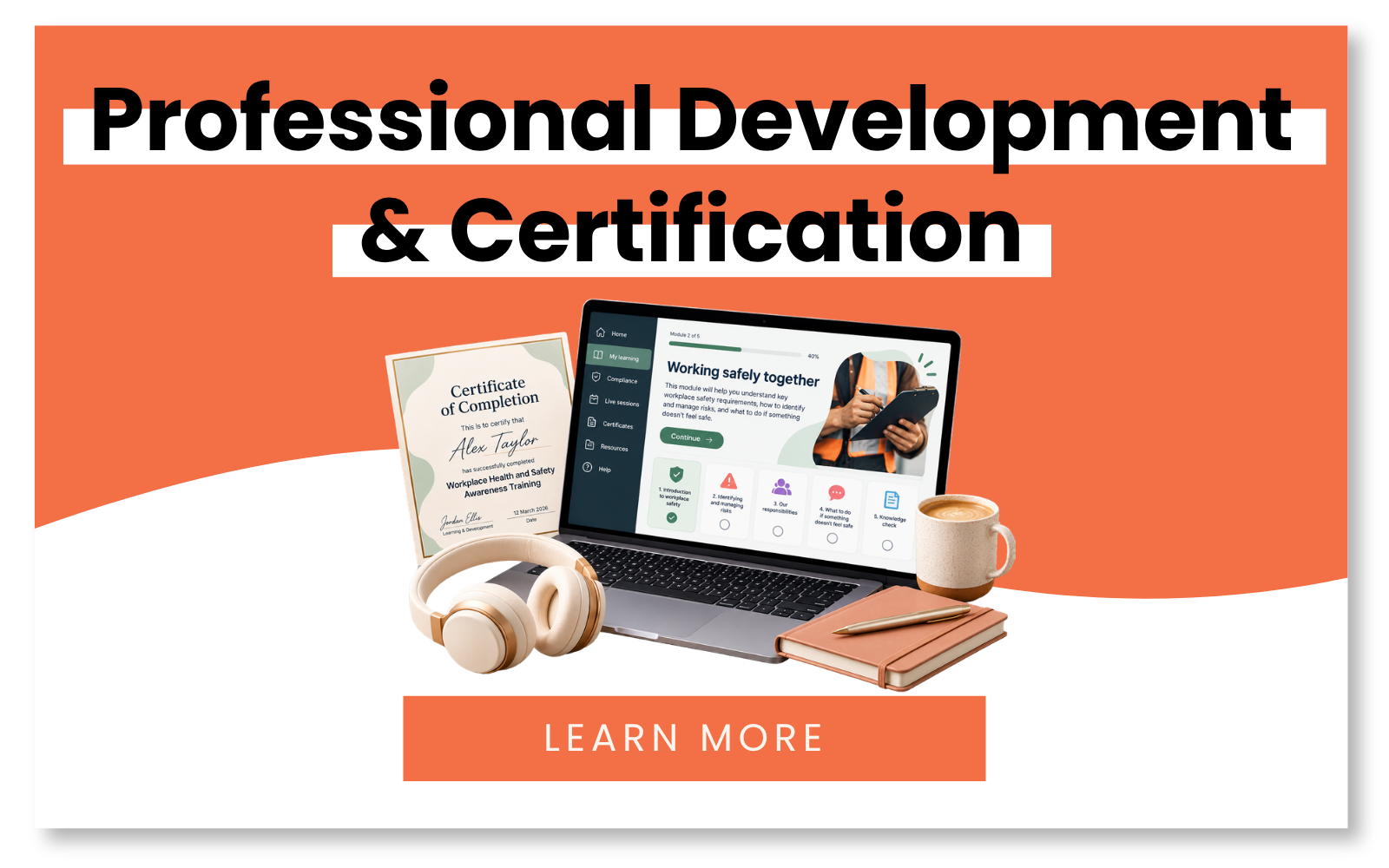
More than a learning module.
An online module can be a great way to introduce knowledge or practise a particular skill. But professional development often goes further.
It might involve facilitated workshops, collaborative activities, coaching, practical demonstrations, workplace projects or a series of learning experiences delivered over time.
The format depends on what people need to achieve. Sometimes the goal is to build awareness. Other times, learners need to demonstrate competence, apply new skills in their workplace or meet specific professional standards.
We help design the whole journey, bringing together the right activities, resources and assessments to support meaningful learning.
How do you know learning has happened?
A quiz at the end of a course isn't always enough. Good assessment starts with a simple question: What should someone be able to do as a result of this learning?
We design knowledge checks and assessments that connect directly to the intended learning outcomes, using the approach that makes the most sense for the skill being developed.
- Knowledge checks: Short quizzes, questions and interactive activities that help learners check their understanding and receive feedback along the way.
- Scenario-based assessments: Realistic situations that ask learners to make decisions and apply what they've learned.
- Practical demonstrations: Opportunities to show a skill in action, rather than simply describe how it works.
- Workplace application: Projects, observations and reflective activities that connect learning to everyday practice.
- Evidence and completion: Clear criteria for what successful learning looks like and how achievement can be recorded.
Making sense of the standards.
Professional learning sometimes comes with an extra layer of complexity: standards, competency requirements, accreditation frameworks and compliance expectations.
With experience as a Curriculum Leader in secondary education, Kat understands the work involved in interpreting curriculum requirements, mapping outcomes and designing assessments that provide meaningful evidence of learning.
That experience brings a practical approach to navigating learning standards across different settings. We can help unpack the requirements, identify what learners need to demonstrate and map learning activities and assessment evidence against the relevant criteria.
This might involve professional learning standards, organisational competency frameworks, mandatory training requirements or industry-specific expectations.
Where formal accreditation or regulated qualifications are involved, we work alongside the appropriate registered or authorised provider to ensure the learning design supports the applicable requirements.
What does certification actually mean?
Not all certificates represent the same thing, and that's an important distinction.
A certificate of participation might recognise attendance at a workshop, while a certificate of completion confirms that someone has finished a learning program. A certificate based on assessed achievement may require evidence that the learner has met defined criteria.
Formal qualifications and regulated credentials have additional requirements, including rules about who can assess and issue them.
We can help design the learning and assessment structure, define completion requirements, organise evidence and create clear certification pathways suited to the purpose of the program.
Professional learning for different worlds.
Every profession and organisation has different learning needs. We adapt the design to suit the people, the environment and the outcomes you're working towards.
That might mean designing professional learning for teachers, leadership development for emerging managers, capability programs for workplace teams or structured learning pathways for staff and volunteers.
Whether the experience is face-to-face, online or blended, our focus stays the same: learning that people can understand, apply and build on.
Have a learning goal in mind?
Whether you're working from a detailed set of standards or starting with an idea for professional development, we'd love to help you shape the next steps.
LET'S HAVE A YARN ↗